
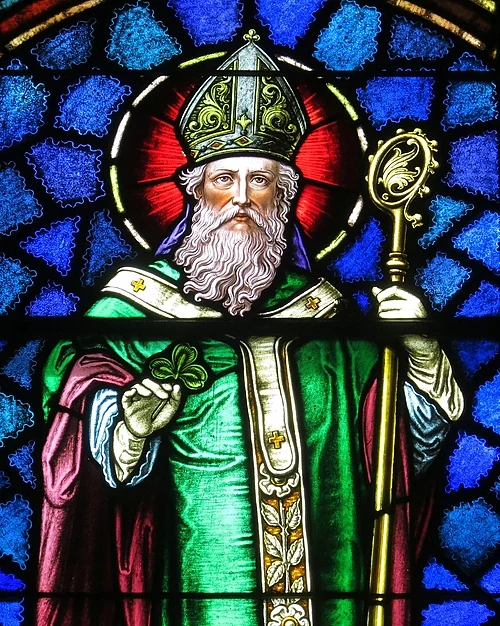
 As we will be meeting on St Patrick's Day, I thought I'd take a brief look at Patrick's world and the historical context. I won't talk much about Patrick himself as his life is now pretty much mired in legend. So I'll just start by saying that he was probably a Romano-Briton who travelled to Ireland around 425-450 AD to proclaim the Christian message. At that time, the Irish still practised Druidism, an animist religion overseen by shamanic priests called Druids. In many ways, Druidism was not unlike native American religions. It had also been practised throughout most of North Western Europe prior to the Roman era and may have continued in Ireland until at least the 8th century.
We think Patrick was born in what was then still Roman Britain. His name is a Roman name, Patricius, which means patrician. The patricians were the ancient Roman aristocratic families (the word derives from 'pater' = father) but they had all died out by Patrick's time, although the name retained its meaning of 'noble.'*
In 407, the commander of the Roman garrison in Britain, a man named Constantine,** declared himself emperor, as Constantine III, and took his soldiers across the Channel to pursue his claim. It didn't go well however and he was defeated and killed by the Western Emperor, Honorius. Constantine's surviving troops were absorbed into the continental Roman army and Britain was left to defend itself. At this point, Patrick may have been a teenager.
Over the next 60 years, eastern Britain was gradually overrun by pagan Germanic peoples from Northern Germany and Southern Denmark (principally the Saxons and Angles).***
Some links with the Empire remained: St Germanus, a Gallic (French) warrior bishop made a couple of trips to Britain (?430 AD), to help the people in their struggles, both theological and military. He may even have crossed paths with Patrick at some point.
But, despite this, it seems that Britain may have reverted, fairly quickly, to the kind of society it had been before the Roman Conquest. This is naturally a matter of great debate among historians. Some believe that Britain had fiercely resisted becoming Romanised and so was able to quickly slip back into its more primitive state. Others argue the polar opposite and, to some extent, recent archaeological finds appear to support this latter view. But the Anglo-Saxon incursions, which may not have involved large numbers of people at any one time, were nevertheless protracted and had the effect of eradicating much of the Celtic and Roman past in the lands settled. Virtually all place names in what would become England are now in the invader's language and the Germanic Old English soon replaced Latin and the Celtic tongue. Spain and Gaul (France), on the other hand, despite also having been countries originally settled by people of Celtic stock, developed languages based on Latin.
If Patrick was descended from native Britons rather than more recent Roman settlers, he may have spoken a local British-Celtic language, of a type that developed into modern Welsh. And if that was the case, he might have been able to communicate with his Irish converts more easily, albeit via some kind of Celtic version of pidgin. It is possible (but not certain) that the Celtic languages spoken in the British Isles in pre-Roman times were mutually intelligible up to a point, allowing for regional variations.
Ireland, like the Scottish Highlands, was never conquered by the Romans, although we think that they established a trading post there. It is therefore possible that a few Irish people spoke passable Latin. Ireland also had links with the west coast of Scotland (Argyll) and there was a lot of to-ing and fro-ing of peoples.
Irish society was probably similar to pre-conquest Britain, with tribal areas and strongholds controlled by local chieftains. Ireland did however boast a High King, who resided at Tara, a fortress in County Meath, but he was probably only a figurehead until the 8th or 9th century. The High King, while Patrick was still a boy, was one of the most famous - Niall of the Nine Hostages.**** One possibility is that Niall died by drowning, around 405 AD, while leading an invasion fleet or large raiding party against Roman Britain. He may have died in rough weather, just off the Isle of Wight (an island near the southern coast of England near Portsmouth). This suggests that he was more than just a figurehead if he was able to muster and command an invasion fleet.***** However, other accounts maintain that he died somewhere in Scotland, although definitely outside Ireland. And it may have been the remnants of Niall's fleet who turned to pirate raiding and captured, among their many victims, a young lad called Patrick - but that's just a guess .
PS. Patrick may have died around the mid 470s AD, when the Roman Empire in the West finally collapsed, despite what some modern historians like to claim.******
* in Patrick's time, the Roman Upper class consisted of a new aristocracy made up of wealthy families and those who had achieved senior positions in society. They were called 'Honestiores' (the more honourable ones), whereas everyone else were the Humiliores (the more humble ones).
** he had no known connection to the original Christian emperor, Constantine, who was also, coincidentally, proclaimed in Britain (York). The Roman army in Britain had been earlier depleted (in 383 AD) by a similar adventurer, called Magnus Maximus (whose name means the Greatest Great One).
*** another figure 'mired in legend' from this period is King Arthur. Whether or not he actually existed and organised British resistance against the Saxon invaders is a matter of debate. Most serious historians have doubts, whereas many amateur enthusiasts have made a good living arguing that he was a real person. In any event, the Saxons eventually prevailed.
**** Geraldine claims that King Niall is one of her ancestors. That would make her an honsestior, whereas I am definitely a humilior (see above * note).
***** imagine how history would have been different if Niall's invasion of Britain had succeeded. But, as with the Spanish Armada nearly 1200 years later, the bad old British weather played a crucial role.
****** it all began with Belgian Historian, Henri Pirenne, (1862-1935), who suggested that the Western Roman empire effectively carried on until the Muslim invasions (7th century onwards). And this view gained traction with Irish historian, Peter Brown, and others, who thought in terms of transformation rather than collapse and coined the term 'Late Antiquity' for this final stage of the, supposedly, continuing Western empire. The Roman Empire in the East, known as the Byzantine Empire, after the town of Byzantium where its capital of Constantinople was built, did however survive until the Fifteenth century.
* * * * *
Some Afterthoughts on St Patrick
Following on from my previous piece about St Patrick's historical milieu, I thought I might focus in a little more detail on a couple of points.
In yesterday's email, I mentioned St Germanus, the French bishop who came to Britain, after the Romans had left, to help with a couple of matters. One of these was the suppression of Pelagianism, a heresy that had arisen in Britain. I have written to P and A about Pelagianism before but, briefly, it concerned a dispute between a monk called Pelagius and St Augustine (the bishop of Hippo). Pelagius felt that we all start with a clean slate and it was up to us individually whether we go to heaven or not, through our actions. We are not burdened by Original Sin. Pelagius was very much playing the Free Will card.
Augustine, on the other hand, felt Original Sin, coupled with God's grace, could not be ignored. This led to a diminution, in some people's minds, of the idea of Free Will.
Broadly speaking, we have ended up with a compromise between the two standpoints. But, at the time, Pelagius was declared a heretic.
Pelagius, according to some accounts, was Irish. He would have been around 30-40 years older than Patrick and so this suggests that Christianity had reached Ireland much earlier. However, it is more likely that Pelagius was British.
But, could Patrick have been a Pelagian Christian? Pelagianism would have been fairly endemic in Britain as he was growing up. A TV movie about the life of St Patrick (made in 2000)* depicts the anti-Pelagian Germanus helping Patrick to mount his mission to Ireland. This may be the filmmakers’ licence but it is thought that Patrick was ordained as a priest by Germanus, when he spent time in Gaul (France) as a young man. This was after escaping from his initial captivity in Ireland. In his own surviving writings, Patrick defends himself against some charges made by other Christians. As far as we can tell (Patrick is a little vague about them) they did not include heresy. And so he is unlikely to have been a Pelagian.
Later Celtic Christianity in Ireland and Western Britain differed in some respects from Roman Christianity but, as far as we can tell, these differences related to relatively minor organisational or liturgical practices, not to fundamental theology.
My final point relates to the ethnic origins of the peoples of these islands following the Fall of the Roman Empire in the West. For a long time it was believed that the Irish, Scots and Welsh were predominantly Celts - the main, pre-Roman inhabitants of the Isles - and the English were of mainly Germanic Anglo-Saxon stock. However, recent work, principally by genetics expert Bryan Sykes, on the DNA of the British and Irish has blown this notion out of the water.** The picture is very complicated but, allowing for some regional variations and a few anomalies, it appears that the Irish, Scots, Welsh and English are quite closely related in DNA terms. The vast majority of us have a lot of DNA relating to the original neolithic inhabitants of the British Isles*** overlaid by DNA from other, later waves of invaders - Celts, Anglo-Saxons, Vikings etc. This suggests that the Anglo-Saxons didn't invade in huge numbers and nor did they either kill or kick everyone else out of what later became England. Rather they intermarried with the locals. In fact, there was a LOT of intermarriage. As with other areas of the world, DNA research is often showing that we are far more closely related than we perhaps like to think.****
So, how does that Sister Sledge song go? Oh, yes, 'We are Family. I got all my sisters and me!'
I think that's a very good note to end on.
Have a happy St Patrick's Day,
Geoff
* 'St Patrick: the Irish Legend', starring Patrick Bergin as the man himself (Fox Family Channel, 2000)
** Bryan Sykes set out his findings in a fascinating book entitled, Blood of the Isles. It is very readable and does not require any specialist knowledge.
*** the earliest inhabitants arrived in various waves and may have originated in Eastern Europe or Asia. They were the people who built the neolithic sites at Stonehenge, Skara Brae and Newgrange. Many of us are related to people who lived here 10,000 years ago.
**** In his excellent book, A Short History of Nearly Everything, Bill Bryson makes the point that, if you go back far enough, you will find that you are related, at some level, to most other people in your part of the world. This is because climatic disasters in the past, eg. major volcanic eruptions etc., have reduced the human race to just a few thousand people at times. Bryan Sykes also makes this point. In fact, ALL of us in P and A will probably have an ancestor in common and perhaps not so far back as you might think. Not even as far back as Niall of the Nine Hostages .